
Small wind in plain terms
Small wind can work well when a property has strong, clean wind, enough land for a tower, supportive local rules and a load that can use the electricity. It is less likely to work on crowded suburban lots, turbulent rooftops or sites where permitting and interconnection costs are high. In the U.S. context, DOE and Pacific Northwest National Laboratory generally classify small wind turbines as machines up to and including 100 kW. That range covers micro turbines for batteries, residential machines, farm-scale systems and larger on-site turbines for rural businesses.
The practical question is not whether a turbine can spin. It is whether the system can produce enough annual kilowatt-hours to justify the tower, foundation, electrical equipment, maintenance and approval process. For broader context on wind energy trends, small wind is best viewed as a distributed energy option, not a scaled-down version of a utility-scale wind farm.

Market data shows why expectations need to be realistic. DOE’s 2024 distributed wind reporting found that distributed wind in the United States reached about 1,110 MW across more than 92,000 turbines installed from 2003 through 2023. Within that category, small wind additions are real but modest compared with utility-scale wind and solar. That makes site screening more important than general enthusiasm for renewable energy.
What makes a site viable
A small wind project starts with the site, not the turbine catalog. DOE WINDExchange guidance says a grid-connected small wind system is more practical where average annual wind speed is at least about 10 mph, utility electricity is relatively expensive, interconnection requirements are not prohibitive and incentives improve the economics. These conditions do not guarantee a successful project, but they provide a reasonable starting point for further review.
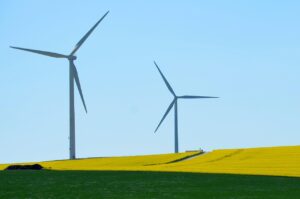
Open rural land is usually better than built-up areas because turbines need smooth airflow. Buildings, trees, hills, barns and future construction can all create turbulence. Turbulence reduces production, increases mechanical loading and can shorten equipment life. DOE guidance notes that a turbine should generally be placed well above surrounding obstacles, with a commonly cited siting rule of 30 feet above anything within a 500-foot horizontal radius. This is one reason serious small wind projects are usually built on ground-mounted towers rather than rooftops.
Property size matters as well. Wind turbines large enough to make a meaningful contribution to a typical home’s electricity use often need room for the tower, setbacks, guy wires if used, maintenance access and safe raising or lowering of equipment. A site may feel windy at ground level and still be unsuitable if zoning limits structure height, neighbors are close, or the only available turbine location is sheltered by trees or buildings.
- Good-fit sites often include farms, ranches, coastal properties with adequate setbacks, ridgelines, rural businesses, water pumping loads and remote facilities facing expensive line extensions.
- Weak-fit sites often include urban rooftops, small residential lots, heavily wooded parcels, valleys with inconsistent winds and locations where height variances are unlikely.
- Borderline sites require measured wind data, installer review and a conservative financial model before equipment is purchased.
Sizing and expected energy output
Turbine size should follow the load and the wind resource. DOE guidance states that residential turbines can range from hundreds of watts to 100 kW, while a 5 kW to 15 kW turbine may be needed to make a significant contribution to the electricity demand of a typical U.S. home, depending on wind speed. Smaller micro turbines can serve cabins, boats, monitoring stations, batteries or small pumps, but they should not be expected to offset a full household load.
The most important number is annual energy output, not the largest power rating in a brochure. Wind turbine power increases with the cube of wind speed, so a modest change in wind speed can create a large change in energy production. The same turbine may perform very differently in a turbulent 9 mph location than it would on a taller tower in clean 12 mph wind. Rotor diameter also matters because swept area determines how much wind the machine can intercept.
Buyers should compare certified power curves and annual energy estimates at realistic average wind speeds. Nominal capacity alone can be misleading if the rated output occurs at a wind speed the site rarely experiences. PNNL’s 2024 distributed wind report found an average net capacity factor of about 13% in 2023 for a sample of 100 small wind projects, with a wide range among projects. That figure should not be treated as a universal forecast, but it illustrates why production estimates must be site-specific.
| Planning question | Why it matters | Practical check |
|---|---|---|
| What is the annual load? | The turbine must be sized to real kWh use, not guesswork. | Review 12 months of utility bills or off-grid load calculations. |
| What is the hub-height wind speed? | Ground-level impressions are often misleading. | Use 30 m to 40 m wind maps for screening, then consider on-site measurement. |
| What are the obstacles? | Turbulence reduces output and durability. | Map trees, buildings, terrain and likely future obstructions. |
| What does the certified energy curve show? | Rated kW is not the same as annual kWh. | Compare annual energy estimates at the site’s expected wind speed. |
Costs, incentives and 2026 policy reality
Small wind costs are highly site-specific. The turbine is only one part of the installed system. A project may also require a tower, foundation, controller, inverter, wiring, trenching, electrical protection, utility studies, inspections, permitting, shipping, crane work and long-term service access. DOE WINDExchange guidance reported a capacity-weighted average installed cost of $5,120 per kW for a small sample of small wind projects installed in 2021, based on 16 projects in three states. That number is useful as historical context, not as a current quote.
In 2026, federal homeowner tax-credit assumptions need special care. The IRS states that the Residential Clean Energy Credit covered qualified residential clean energy property, including wind turbines, installed from 2022 through December 31, 2025, and is not available for property placed in service after December 31, 2025. Homeowners evaluating small wind after that date should not build a financial case around the former 30% residential credit unless their tax professional confirms eligibility for their specific timing and situation.
Commercial, farm and nonprofit projects may have different incentive pathways, including state programs, utility programs or agricultural energy grants where available. USDA’s Rural Energy for America Program has historically been important for rural renewable energy projects, and DOE and USDA announced the RAISE initiative in 2024 to support distributed wind deployment for farmers and rural stakeholders. Grant windows, eligibility rules and funding levels change, so project owners should verify current program rules before including incentives in a payback calculation.
A conservative economic model should include maintenance, insurance, financing costs, equipment replacement risks and the value of exported electricity. Net metering, net billing and avoided-cost compensation differ by state and utility. In some areas, excess generation has high value; in others, it may be credited at a lower rate. For small wind, the tariff can matter almost as much as the turbine.
Equipment, certification and permitting checks
Certification is one of the clearest ways to separate serious equipment from unsupported claims. PNNL tracks small and medium wind turbines certified to standards such as AWEA 9.1-2009, ANSI/ACP 101-1-2021 and relevant IEC standards. As of July 2026, PNNL’s certified small wind turbine list included a limited number of models, with certified power ratings, sound information and applicable standards. The small number of listed machines is a reminder that independent certification is not automatic across the market. See also: clean energy.
ICC-SWCC certification labels can help buyers compare annual energy production, rated power and sound levels using standardized methods. Certification does not remove the need for engineering review. Tower design, foundation design, electrical safety listing, local code compliance, lightning protection and interconnection requirements still have to be addressed for the actual site.
Permitting should be checked before deposits are paid. Some local ordinances limit structure height, require setbacks based on tower height, regulate sound, require visual-impact review or trigger public hearings for variances. DOE guidance notes that many zoning ordinances historically included 35-foot height limits, which are often too low for productive small wind systems. A project that depends on a height variance carries a different risk profile from one that fits existing rules.
- Ask whether the turbine has current third-party certification, and request the certificate, label and summary report.
- Ask which tower types are approved by the manufacturer and who will engineer the foundation.
- Confirm whether the inverter, controller and protection equipment meet utility and electrical-code requirements.
- Request references for similar wind speeds, tower heights and climates, not just general customer testimonials.
- Clarify warranty terms, maintenance intervals, replacement parts availability and who performs service locally.
Grid-tied, off-grid and hybrid designs
A grid-tied small wind system can reduce purchases from the utility and may export excess electricity when wind production exceeds on-site demand. DOE guidance explains that grid-connected systems usually rely on the utility as backup, while net metering or net billing rules determine how exported electricity is valued. Utility approval is normally required, and interconnection agreements may include metering, safety equipment, inspections and power-quality requirements.
Off-grid wind is a different design problem. Remote cabins, farms, telecom sites and villages may use wind with batteries, diesel backup, solar photovoltaics or other resources. Hybrid solar-wind systems can be useful because many regions have stronger winds in seasons when solar output is lower. That complementarity is site-dependent, but it can reduce the size of storage or backup generation compared with a single-resource system.
Rooftop wind deserves caution. DOE guidance notes that rooftop turbines face vibration, noise transmission and turbulent airflow, which can reduce production and equipment life. A small turbine on a short mast may be visible and active without producing much useful energy. For most serious projects, a properly sited tower on the ground is more credible than a decorative rooftop installation.
The practical conclusion is straightforward: use wind where wind is strong, clean and accessible. Use solar where the site has sun but poor wind. Use a hybrid system where the resources genuinely complement each other and where the added controls, batteries and maintenance can be justified.
Frequently asked questions
Is small wind good for a typical suburban home?
Often, no. A typical suburban lot may lack the tower height, setback distance and clean airflow needed for strong performance. Suburban zoning and neighbor concerns can also make permitting harder. Some edge-of-town or large-lot properties may qualify, but they need site-specific review.
How big should a home wind turbine be?
It depends on annual electricity use and wind speed at hub height. DOE guidance indicates that a 5 kW to 15 kW turbine may be needed to make a meaningful contribution to a typical home’s demand, but a smaller turbine can be appropriate for batteries, pumps or low-load applications.
Does a higher tower really matter?
Yes. Wind speeds generally increase with height, and a taller tower can also move the rotor above turbulence created by trees, buildings and terrain. Because wind power is highly sensitive to wind speed, tower height can have a major effect on annual energy output.
Are vertical-axis turbines better for small wind?
Not automatically. Vertical-axis turbines can have niche uses, but horizontal-axis turbines remain the most common small wind design in the market. Buyers should compare certified annual energy data, sound information, service history and site suitability rather than choosing by rotor style alone.
What is the biggest mistake buyers make?
The biggest mistake is buying a turbine before confirming wind resource, tower feasibility, permits, interconnection rules and certified performance data. A small wind project is usually won or lost in the site assessment and due-diligence stage, not in the brochure.