
What floating wind turbines are
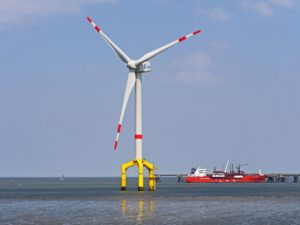
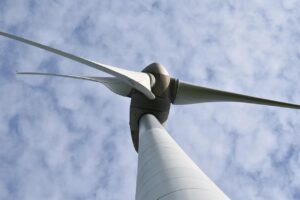
Floating wind turbines are offshore wind turbines installed on buoyant platforms and secured to the seabed with mooring lines and anchors, rather than fixed directly into the ocean floor. Their main value is access. They can operate in deep waters where bottom-fixed monopiles or jackets become difficult, costly or impractical. This matters for regions such as the U.S. West Coast, Japan, parts of the Mediterranean and deeper Atlantic waters, where strong wind resources often lie beyond the shallow-water zone.
The technology is no longer just a laboratory concept, but it is still at an early commercial stage. Pilot projects have shown that floating wind can work. The harder question is how quickly costs can fall, and whether ports, supply chains, grid connections and permitting processes can mature enough to support gigawatt-scale projects.
For readers tracking broader wind power trends, Econergy’s wind energy section covers related developments across offshore and onshore markets.
Why deepwater wind is becoming strategically important
Most offshore wind capacity installed so far has used fixed-bottom foundations in relatively shallow seas, especially in China and northern Europe. According to the Global Wind Energy Council’s Global Offshore Wind Report 2026, global offshore wind installations reached 92.5 GW by the end of 2025, after 9.3 GW of new offshore capacity was grid-connected during 2025. Floating wind is still only a small fraction of that total, but it targets a different resource base.
The International Energy Agency identifies floating foundations as a way to tap offshore wind resources in waters beyond roughly 50 to 60 meters, where conventional fixed foundations become less attractive. The U.S. Department of Energy has made a similar point for the American market, stating that about two-thirds of U.S. offshore wind energy potential is in waters too deep for today’s fixed-bottom foundations. For that reason, floating wind is usually better understood as an expansion path for coastlines with limited developable shallow seabed, not simply as a substitute for fixed-bottom offshore wind.
The strategic value is also geographical. Floating wind can place turbines farther from shore and, in some cases, closer to stronger and steadier winds. Greater distance can reduce some visual concerns compared with nearshore projects, although it does not remove environmental, fisheries, navigation or transmission issues.
How floating wind differs from fixed-bottom offshore wind
The turbine above the waterline may look familiar, but the project design is different. A floating turbine is a coupled system made up of the turbine, floating platform, moorings, anchors, dynamic power cables and offshore grid connection. Waves, wind and currents move through the whole structure, so the engineering focus is not just the turbine or the foundation, but how the complete system behaves offshore.
| Factor | Fixed-bottom offshore wind | Floating offshore wind |
|---|---|---|
| Typical water depth | Best suited to shallower sites | Designed for deeper waters, often beyond 50-60 meters |
| Foundation | Monopile, jacket or gravity-base structure fixed to seabed | Buoyant platform held by moorings and anchors |
| Installation model | Often relies heavily on offshore heavy-lift installation | More assembly can occur at port before tow-out, depending on design |
| Power cable | Static export and array cables | Dynamic cables must tolerate platform motion |
| Main challenge | Seabed works, vessels, supply chain and grid | Platform cost, moorings, dynamic loads, ports, cables and serial production |
This comparison explains why floating wind has a different cost profile. It may reduce some seabed construction constraints, but it adds complexity in platform fabrication, motion control, mooring design and cable durability. The commercial opportunity depends on whether those added costs can fall through standard designs, larger order books, repeatable port processes and stronger supply chains.
Main floating platform types
Industry reports usually group floating foundations into three leading concepts: spar buoys, semi-submersibles and tension leg platforms. Each concept solves the same basic problem—keeping a large turbine stable offshore—but uses a different balance of buoyancy, ballast, footprint, port requirements and mooring tension.
Spar buoy platforms
A spar uses a long, deep floating column with ballast low in the structure. This creates stability through a low center of gravity. Spars have operating experience, including Equinor’s Hywind projects, but their draft can require deepwater ports or specialized assembly methods. That port constraint is one reason spars may not fit every market, even where the wind resource is strong.
Semi-submersible platforms
Semi-submersible designs use multiple buoyant columns connected by bracing or pontoons. They generally have shallower draft than spars, which can make quayside assembly and tow-out easier in some port settings. WindFloat Atlantic in Portugal is a well-known example of a semi-submersible floating wind project. The trade-off is that the structure can be large and steel-intensive, so manufacturing efficiency is central to cost reduction.
Tension leg platforms
Tension leg platforms use taut mooring lines to limit movement. This can reduce platform motions and seabed footprint, but installation and anchoring require precision. France’s Provence Grand Large pilot, fully commissioned in June 2025 according to EDF, uses tension leg platform technology and provides an important real-world reference for this approach.
What recent projects show about market maturity
Floating wind has moved through prototypes, pilots and early arrays. The installed base remains small compared with fixed-bottom offshore wind, but the project list is becoming more diverse by geography, platform design and use case.
| Project | Location | Capacity | What it demonstrates |
|---|---|---|---|
| Hywind Scotland | United Kingdom | 30 MW | Early multi-turbine floating wind operation |
| WindFloat Atlantic | Portugal | 25 MW | Semi-submersible platform operation since 2020 |
| Kincardine | Scotland | About 50 MW | Commercial-scale array experience near Aberdeen |
| Hywind Tampen | Norway | 88 MW | Floating wind supplying offshore oil and gas installations |
| Provence Grand Large | France | 25 MW | Tension leg platform pilot in the Mediterranean |
GWEC’s 2026 offshore report put net global floating wind installations at 278 MW by the end of 2025 and noted that no floating wind capacity was commissioned in 2025, the first such pause since 2015. That pause should not be read as a technology failure. It is better understood as a sign that the sector is between demonstration projects and larger commercial leasing rounds. Projects under construction or awarded in Europe and Asia are intended to test whether floating wind can move from one-off engineering to repeatable infrastructure delivery. See also: clean energy.
The main barriers to scaling floating wind turbines
The first barrier is cost. The U.S. Department of Energy’s Floating Offshore Wind Shot targets a reduction of more than 70% in floating offshore wind energy costs, to $45 per megawatt-hour by 2035 for deepwater sites far from shore. That target is useful because it shows both ambition and distance: floating wind is expected to become cheaper, but it is not yet a low-cost bulk power option in most markets.
The second barrier is port readiness. Floating turbines are very large industrial systems. Ports need heavy-lift capacity, deep berths, storage areas, wet storage options, tow-out routes and space for serial assembly. IRENA’s 2024 floating offshore wind outlook emphasized port capability as a core requirement, not a secondary detail. Without suitable ports, the theoretical advantage of quayside assembly becomes much harder to capture.
The third barrier is the grid. Deepwater sites may sit far from strong onshore connection points. Export cables, offshore substations, transmission planning and cost allocation can become decisive. Floating platforms also require dynamic array cables that can handle movement over decades, which adds engineering and qualification requirements.
The fourth barrier is social license. Floating projects may be farther offshore, but they still interact with fisheries, tribal and coastal communities, shipping routes, military uses, seabed habitats, birds and marine mammals. Faster permitting does not simply mean fewer reviews. In practice, it means earlier data collection, clearer rules, better spatial planning and more credible community engagement.
What to watch next
The next phase of floating wind will be shaped by practical indicators, not headline capacity targets alone. Watch whether governments design auctions that reward deliverability, not just the lowest nominal power price. Watch whether ports receive investment before projects reach final investment decision. Watch whether developers standardize platform designs enough for serial manufacturing. Also watch whether early commercial projects can prove acceptable availability, cable reliability and maintainable operations in rough sea conditions.
The United Kingdom’s Celtic Sea leasing process, France’s Mediterranean floating tenders and U.S. deepwater ambitions show why policymakers remain interested. But the timing of large-scale deployment will depend on financing, grid buildout, port upgrades and local acceptance. For now, floating wind turbines are best understood as an enabling technology: they unlock high-quality wind areas that fixed foundations cannot economically reach, but they still need industrial learning before they can become a mainstream offshore wind option.
Frequently asked questions
Are floating wind turbines already operating?
Yes. Several floating wind projects are operating, including arrays in Scotland, Portugal, Norway and France. However, global installed floating capacity remains small compared with the broader offshore wind market, which is still dominated by fixed-bottom projects.
Why not use fixed-bottom turbines everywhere?
Fixed-bottom foundations work best in shallower waters. In deeper waters, foundation size, installation complexity and cost can rise sharply. Floating foundations allow turbines to be deployed where the seabed is too deep for conventional fixed structures.
Do floating wind turbines move?
Yes, but within engineered limits. The platform responds to waves, wind and currents, while mooring lines and control systems keep motion within the design envelope. Managing this movement is one of the central engineering tasks for floating wind.
Will floating wind be cheaper than fixed-bottom offshore wind?
Not in the near term for most sites. Floating wind is currently less mature and usually more complex. Its value is access to deeper, stronger wind resources. Costs may fall as projects scale, designs standardize and supply chains improve, but that outcome depends on execution.
Which regions are most suitable for floating wind?
Regions with strong winds and deep coastal waters are the clearest candidates. Examples include parts of the U.S. Pacific Coast, Japan, South Korea, the Mediterranean, Norway, Portugal and deeper areas around the United Kingdom and Ireland.