
What Vestas wind technology means in practical terms
Vestas wind technology is best understood as a platform approach to wind power, not as one turbine model or a simple race for higher nameplate capacity. The company’s current portfolio combines larger rotors, flexible ratings, full-scale power conversion, modular nacelle concepts, digital monitoring, service analytics and circularity work. In offshore wind, the clearest example is the V236-15.0 MW turbine, a 15 MW machine with a 236-meter rotor. In onshore wind, the EnVentus platform, including the V172-7.2 MW, shows how Vestas applies similar design logic to low and medium wind sites.
The practical direction is not just “bigger turbines.” It is a shift toward turbines that can be manufactured, transported, installed, serviced and optimized under real project conditions.
This article synthesizes Vestas product specifications, Vestas Annual Report 2025, Vestas Q2 2026 investor information, and Vestas service and digital materials available by August 2026. For broader industry context, see our wind energy coverage.
For project developers, owners and energy-market observers, the value of Vestas technology comes down to three linked questions: how much energy a turbine can capture, how reliably it can operate over decades, and how efficiently the manufacturer and service network can support it after installation.
The offshore anchor of the portfolio is the V236-15.0 MW
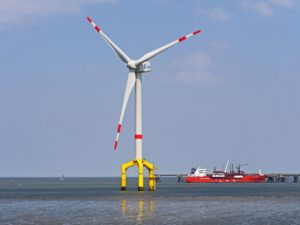
The V236-15.0 MW is the most visible expression of Vestas wind technology in offshore wind. Vestas introduced the turbine to the market in February 2021 and positions it as a machine that combines elements from its EnVentus and 9 MW platforms. The turbine has a rated power of 15,000 kW, 115.5-meter blades, a 236-meter rotor diameter and a swept area of 43,742 square meters.
Those figures matter because swept area is central to energy capture. A larger rotor can intercept more wind, especially at sites where annual energy production depends on output across a wide range of wind speeds. Vestas states that a single V236-15.0 MW can produce up to about 80 GWh per year under site-specific conditions, and that the turbine can achieve a capacity factor above 60 percent depending on the project site.
| Technology marker | V236-15.0 MW offshore turbine | Why it matters |
|---|---|---|
| Rated power | 15 MW | Higher unit output can reduce the number of turbines needed for a given project size. |
| Rotor diameter | 236 meters | A larger rotor increases the wind area available for energy capture. |
| Swept area | 43,742 square meters | Useful for understanding annual energy production potential. |
| Blade length | 115.5 meters | Shows the scale of offshore blade manufacturing and logistics. |
| Design life | 30 years, according to Vestas product information | Longer asset life can improve project economics if performance and maintenance targets are met. |
Offshore technology, however, is not judged by turbine specifications alone. Industrialization is just as important. Vestas said in its 2025 Annual Report that 52 V236-15.0 MW turbines were installed during 2025 and that the platform showed commercial-scale signs of performance potential as turbines at He Dreiht and Baltic Power began operating. The same report also noted production bottlenecks and delays during the ramp-up. That qualification matters: new turbine platforms have to prove engineering performance and supply-chain repeatability.
EnVentus shows the onshore version of the same technology logic
Onshore wind faces a different set of constraints from offshore wind. Turbines must fit road transport limits, local permitting rules, acoustic requirements, grid conditions, crane availability and site-specific wind classes. Vestas addresses these constraints through its EnVentus platform, where modularity and flexible ratings can be more important than maximum nameplate capacity alone.
The V172-7.2 MW is a useful example. Vestas describes it as a turbine for low to medium wind conditions with flexible ratings of 6.5 MW, 6.8 MW and 7.2 MW. The model has a 172-meter rotor, a swept area of 23,235 square meters, a 3 m/s cut-in wind speed and a 25 m/s cut-out wind speed. Available hub-height options range from 114 meters to 199 meters, depending on configuration and market requirements.
Vestas says the V172-7.2 MW improves annual energy production by 12 percent in low wind conditions through changes to the powertrain and power conversion systems. That statement should be read as model-specific and condition-dependent, not as a universal performance guarantee for every wind farm. Site wind distribution, wake losses, grid curtailment, permitting limits and operations strategy still determine final output.
The EnVentus approach is relevant because it connects turbine hardware with project flexibility. A developer may need a lower rating to comply with load or grid constraints, a taller tower to access better wind resources, or cold- and hot-climate options to match local operating conditions. Flexible turbine platforms can help manufacturers serve more sites without creating a completely new machine for every market.
Software and service turn turbines into operating platforms
Modern wind turbines are software-controlled industrial assets. Vestas has described software as essential to turbine design, operation and cost-effective maintenance. This is not a minor add-on. Pitch control, power conversion, condition monitoring, operating modes, alarms, remote diagnostics and performance optimization all depend on software and data infrastructure.
Vestas’ digital services materials describe tools such as VestasOnline, VestasDeveloper and Scipher. The company says Scipher covers more than 128 GW of assets, more than 55,000 turbines and assets in more than 70 countries. These figures show how data scale has become part of wind technology itself. A large operating dataset can support predictive maintenance, performance benchmarking and faster identification of abnormal turbine behavior.
Service scale also matters. Vestas reports about 165 GW of capacity under service, more than 56,000 turbines under service and service operations in 71 countries. These numbers help explain why wind technology should be evaluated across the whole asset life cycle. A turbine that looks strong on a specification sheet still needs spare parts, trained technicians, remote monitoring, upgrade paths and maintenance planning for decades.
Why full-scale converters and control systems matter
Product information for both the V236-15.0 MW and V172-7.2 MW lists full-scale converters. In practical terms, power electronics help manage how variable turbine output is converted and delivered to the grid. For project owners, the grid interface is increasingly important because wind farms must meet local grid-code requirements, provide stable output behavior and operate in systems with growing shares of variable renewable energy.
Why upgrades are part of the technology story
Vestas also markets PowerPlus upgrades for existing turbines, including control-system changes, software features, aerodynamic add-ons, power modes and cut-out strategy improvements. Vestas says these upgrades can increase annual energy production by up to 5 percent, depending on turbine and site conditions. The key point is that wind technology is no longer fixed at commissioning. Operators increasingly expect performance improvements through software, retrofits and operational learning. See also: clean energy.
Technology limits and trade-offs investors should watch
The strongest reading of Vestas wind technology is a balanced one. The company has deep turbine experience, a large service base and advanced offshore and onshore platforms. Large-turbine technology, however, also brings execution risk.
- Manufacturing complexity: Very large blades, nacelles and towers require specialized factories, quality control and transport planning.
- Ramp-up risk: Vestas’ own 2025 reporting noted bottlenecks and delays during the V236 production ramp-up, even as the company described progress in reducing takt times.
- Logistics constraints: Offshore turbine components need port capacity, installation vessels and weather windows. Onshore turbines face road, bridge and permitting limits.
- Grid integration: Higher renewable penetration increases the importance of power electronics, forecasting and grid compliance.
- Site-specific performance: Capacity factor, output and upgrade benefits depend on wind resource, layout, curtailment, availability and maintenance execution.
Vestas’ Annual Report 2025 also described a mindset shift in offshore wind toward “better, not bigger” turbines. That is an important industry signal. Larger prototypes may attract attention, but bankable projects need proven production, predictable installation, stable service strategies and reliable output assumptions.
Circularity is becoming part of wind technology
Wind technology is increasingly evaluated not only by megawatts and cost of energy, but also by material use, recyclability and end-of-life planning. Vestas has set an ambition to produce zero-waste wind turbines by 2040. In its 2025 reporting, the company said it achieved a 94 percent recyclability rate for hub and blade, recycled 109 blades from repowering projects in the United States, and reached a 69 percent recycling rate in its own operations.
Blade circularity is especially important because composite blades have historically been difficult to recycle at high value. Vestas has discussed a solvolysis-based route for epoxy-infused blades through the CETEC initiative and cooperation with partners including Stena Recycling. The strategic relevance is clear: as wind fleets age, owners and regulators will pay more attention to what happens at repowering or decommissioning.
For readers comparing turbine manufacturers, circularity claims should be checked carefully. The strongest claims are tied to published methodology, third-party review, defined turbine configurations and clear boundaries. Vestas notes that some sustainability metrics for specific turbine configurations are based on internal assessment, so they should be treated as useful indicators rather than universal project-level results.
What this means for wind project planning
For offshore projects, Vestas wind technology points toward fewer, higher-output turbines supported by a maturing supply chain. The V236-15.0 MW can reduce turbine count for large projects, but its practical value depends on installation timing, port readiness, vessel availability, grid connection schedules and long-term service planning.
For onshore projects, the EnVentus platform suggests a different priority: adapting large rotors and flexible ratings to local constraints. A turbine such as the V172-7.2 MW may be attractive in lower wind regimes because rotor size and hub height can improve energy capture, but the right choice still depends on permitting, transport routes, noise limits, shadow-flicker rules and grid requirements.
For asset owners, the main conclusion is that turbine selection should include lifetime operation, not only capital cost. Digital monitoring, service contracts, upgrade pathways and spare-parts availability can influence the real economics of a wind farm as much as the initial turbine model.
Frequently asked questions
What is Vestas wind technology?
Vestas wind technology refers to the company’s turbine platforms, rotor and blade designs, nacelle architecture, power electronics, software, service tools, data analytics and circularity work. It covers both new turbine models and lifetime optimization of installed assets.
Which Vestas turbine is most important for offshore wind?
The V236-15.0 MW is Vestas’ key current offshore turbine platform. It has a 15 MW rating, a 236-meter rotor and 115.5-meter blades. Vestas reported that 52 units were installed during 2025 as early commercial projects moved forward.
How does EnVentus differ from offshore turbine technology?
EnVentus is an onshore platform designed around flexible ratings, site adaptability and transportable modular architecture. Offshore technology places more emphasis on very large unit output and marine installation, while EnVentus must also fit land-based logistics, permitting and local operating conditions.
Is Vestas focused only on building bigger turbines?
No. Larger rotors and higher ratings remain important, but Vestas’ recent strategy emphasizes reliable, efficient and industrialized platforms. The company’s own 2025 discussion of offshore wind highlighted a shift toward better and more predictable turbine solutions rather than an endless size race.
Why are digital services important in wind power?
Digital services help operators monitor turbine status, plan maintenance, analyze performance and connect operational data with asset-management systems. In modern wind farms, software and data are part of the technology stack that supports availability and lifetime energy production.