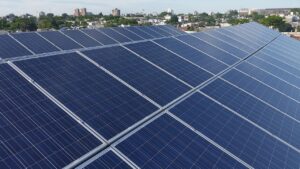

What a home solar system means in 2026
A home solar system is a coordinated package of rooftop or ground-mounted solar panels, inverters, electrical protection equipment, monitoring, utility interconnection, and, in some cases, battery storage. In 2026, the main question is not whether solar panels work. They do. The more important question is whether the system design, installed price, export-credit rules, financing structure, roof condition, and backup requirements fit a particular household.
Federal policy has also changed materially. The IRS states that the Residential Clean Energy Credit is not available for qualifying home clean energy property placed in service after December 31, 2025. That makes quote comparison and local incentive checks more important than they were when many buyers could model a 30% federal credit.

For more context on solar industry developments, visit the Econergy solar section.
What is included in a complete home solar system
A complete residential solar installation includes more than the panels visible from the street. The main components usually include photovoltaic modules, racking, an inverter system, wiring, disconnects, monitoring hardware or software, a utility meter arrangement, permits, inspection, and interconnection approval. If backup power or time-of-use bill management is part of the goal, the design may also include a battery, a battery inverter, a critical-loads panel, and controls that determine when to charge or discharge.
The panels produce direct current electricity. The inverter converts that electricity into alternating current for use in the home. Modern systems may use string inverters, microinverters, or power optimizers. Each option has trade-offs in cost, shade tolerance, monitoring detail, and serviceability. A simple, largely unshaded roof may not need the most complex electronics, while a roof with multiple orientations or partial shading may benefit from module-level power electronics.
Storage is optional, not automatic. A grid-tied solar-only system normally shuts down during an outage for worker-safety reasons unless it has approved equipment that can isolate it from the grid. A solar-plus-storage system can be designed to keep selected circuits operating, but backup duration depends on battery capacity, household load, weather, and how much solar production is available during the outage.
Key 2026 facts to verify before you buy
The home solar market is shaped by several information sources, and they do not all answer the same question. Government tax pages explain eligibility rules. Market reports show pricing and adoption trends. Technical tools estimate local output. The table below separates these data points so homeowners do not confuse a national average with a project-specific result.
| Source or data set | What it indicates | Why it matters for a homeowner |
|---|---|---|
| IRS Residential Clean Energy Credit guidance and OBBB FAQ | The 30% Section 25D residential clean energy credit applied to eligible property installed from 2022 through December 31, 2025, and the IRS says installation completed after that date prevents claiming the credit. | Do not assume a purchased 2026 home solar system receives the former federal residential credit unless a qualified tax professional confirms a specific exception. |
| EnergySage 23rd Home Electrification Marketplace Report, released September 30, 2026 | Median quoted solar pricing rose about 3% to $2.57 per watt in H1 2026, while solar-only pricing held flat at $2.62 per watt on its marketplace. | National quote data is useful as a reasonableness check, but roof conditions, equipment choices, labor, local rules, and financing can move an actual quote above or below that figure. |
| Wood Mackenzie and SEIA Q3 2026 market commentary | Residential installations softened after the expiration of the 25D tax credit, with Q2 2026 residential solar installations reported at 995 MWdc. | A softer market may affect installer competition and sales tactics, but it does not automatically mean every homeowner will receive a lower price. |
| U.S. Energy Information Administration Electric Power Monthly | Residential small-scale solar PV capacity was listed at about 40.5 GW for 2025, with January 2026 preliminary capacity slightly higher. | The installed base is large enough that solar is no longer experimental, yet utility rules remain highly local. |
| DOE and NREL resources including PVWatts and cost benchmarks | PVWatts estimates production from location and system inputs; DOE benchmark work describes representative PV and storage system assumptions. | Use national benchmarks for context, but size and savings should be modeled for the address, roof, rate plan, and export rules. |
How to size a home solar system
System sizing should start with electricity use, not available roof area. The most useful document is a full year of utility bills showing monthly kilowatt-hour consumption. A household with electric heating, air conditioning, a pool pump, an EV charger, or planned electrification upgrades may need a larger system than historical bills suggest. A household planning efficiency upgrades may be able to meet its goals with fewer panels.
Four practical sizing inputs matter most:
- Annual electricity consumption: Twelve months of kWh use show the load that solar is trying to offset.
- Roof geometry and shading: South-facing roofs are often productive in the Northern Hemisphere, but east-west roofs can also work well, especially under time-of-use rates. Shade from trees, chimneys, and neighboring buildings can reduce output.
- Utility export rules: Full-retail net metering, reduced export credits, and time-varying rates can all lead to different optimal system sizes.
- Future loads: EV charging, heat pumps, induction cooking, or a home battery can change the value of daytime production.
Many homeowners ask for a system that offsets 100% of annual use. That can be sensible where export credits are favorable. In markets with lower export compensation, a smaller system designed around daytime self-consumption may produce better economics. The right target is not a universal percentage; it is the design that delivers the best mix of bill savings, resilience, roof use, and investment risk.
What a home solar system costs in 2026
Cost should be evaluated in dollars per watt, total contract price, equipment quality, financing terms, and included services. EnergySage reported a median quoted solar price of $2.57 per watt for the first half of 2026, before incentives, on its marketplace. At that benchmark, an 8 kW system would be roughly $20,560 before battery, local incentives, roof work, panel upgrades, or financing costs. This is not a universal quote; it is a national marketplace indicator.
Several items can explain why two quotes for the same home differ:
- Equipment selection: Higher-efficiency modules, microinverters, premium batteries, and extended monitoring can raise the upfront price.
- Roof complexity: Steep roofs, tile roofs, multiple roof planes, or limited attic access increase labor.
- Electrical upgrades: Main panel upgrades, service changes, or trenching can be significant adders.
- Financing structure: Some loans include dealer fees or higher lifetime interest costs even when the monthly payment looks attractive.
- Warranty and service scope: Workmanship warranties, production guarantees, monitoring support, and roof-penetration coverage vary by installer.
The end of the federal residential credit for new post-2025 owned systems also changes the payback calculation. In 2024 or 2025, many buyers compared net cost after a 30% federal tax credit. In 2026, a cash buyer generally needs to evaluate the pre-credit installed price unless local, state, utility, or other incentives apply.
Third-party ownership options such as leases and power purchase agreements may become more visible because some providers can structure projects under different commercial tax rules. Homeowners should still compare the contract price per kWh, escalator, buyout terms, transfer rules, and maintenance obligations rather than treating third-party ownership as automatically cheaper.
How batteries change the economics and the purpose
A battery changes a home solar system from a bill-offset tool into a more flexible energy system. It can store midday solar production for evening use, reduce imports during expensive time-of-use periods, and support selected loads during outages. It also adds cost and design complexity, so the decision should be tied to a clear purpose.
EnergySage reported that self-reported homeowner interest in battery storage reached 76% in H1 2026, while actual attachment was lower at 31%. That gap is important. Many households want backup, but not all are ready to pay for the battery capacity required to back up large loads such as central air conditioning, electric ovens, or whole-home heating. A critical-loads design that backs up refrigeration, lights, internet, outlets, and some medical or work-from-home needs may be more cost-effective than trying to run every circuit as usual. See also: clean energy.
Battery specifications should be read carefully. Capacity, measured in kilowatt-hours, tells you how much energy the battery can store. Power, measured in kilowatts, tells you how much load it can support at one time. Warranty terms often depend on years, cycles, and retained capacity. A system with a single battery may be adequate for short evening shifting, while a household seeking multi-day resilience may need more capacity, load management, or a generator integration strategy.
How to compare quotes without focusing only on price
The lowest contract price is not always the lowest-risk choice. A strong quote should clearly show system size in kWdc, estimated first-year production in kWh, panel model, inverter model, battery model if included, roof layout, expected utility bill impact, warranty terms, payment schedule, and all adders. It should also state whether tree work, roof repair, main panel upgrades, permit fees, and interconnection fees are included or excluded.
Use this checklist before signing:
- Compare at least two or three quotes using the same system size and a similar equipment class.
- Ask for the production model assumptions, including azimuth, tilt, shading, and degradation.
- Confirm whether the installer modeled your current utility tariff or only used an average electricity price.
- Separate the cash price from the financed price so loan fees and interest are visible.
- Check installer licensing, insurance, workmanship warranty, and service response process.
- Review roof age. If replacement is likely within the next few years, coordinate roof and solar timing.
- Read lease or PPA escalators, buyout clauses, home-sale transfer language, and performance obligations.
Payback is best calculated as a range, not a single promise. Divide net project cost by estimated annual savings, then test what happens if production is lower, electricity rates change more slowly than expected, export credits fall, or maintenance costs appear. A credible installer should be comfortable showing sensitivities rather than relying on one optimistic scenario.
When a home solar system makes the most sense
Solar tends to be most compelling when the home has a durable roof, good sun access, meaningful daytime or annual electricity consumption, high retail electricity rates, stable ownership plans, and utility rules that reward on-site generation. It may be less compelling if the roof needs replacement soon, shading is severe, electricity use is very low, local export credits are weak, or the homeowner expects to move before savings can accumulate.
A difficult site is not always a non-starter. Ground mounts, tree trimming, panel-level electronics, load shifting, or battery storage can sometimes solve design problems. The key is to identify which problem is being solved. If the goal is lower bills, prioritize cost per kWh saved. If the goal is outage resilience, prioritize backup architecture and load management. If the goal is long-term electrification, leave room for future EV charging and heating loads.
The 2026 market requires more careful math than the incentive-rich period that preceded it. Even so, solar remains a mature technology with a large U.S. installed base and improving design tools. A homeowner who verifies tax assumptions, models site-specific production, compares contract structures, and understands utility export rules can make a better decision than one who shops only by monthly payment.
Frequently asked questions
How large should a home solar system be?
It should be sized from a full year of electricity use, roof conditions, local solar resource, utility export rules, and future loads. A 100% annual offset is not always the best target; in some rate structures, a smaller system with higher self-consumption can be more economical.
Is a battery required for residential solar?
No. A grid-tied solar-only system can reduce electricity purchases without a battery. A battery is mainly useful for backup power, time-of-use management, or increasing self-consumption when export credits are low.
Does the federal residential solar tax credit still apply in 2026?
For typical customer-owned residential systems, the IRS says the Section 25D credit is not available for property placed in service after December 31, 2025. Tax rules can be fact-specific, so homeowners should confirm with a qualified tax professional before relying on any incentive claim.
How should homeowners compare a solar loan with a lease or PPA?
Compare total lifetime cost, monthly payment, annual escalator, ownership of incentives, maintenance responsibility, buyout rights, home-sale transfer terms, and expected savings under your actual utility rate. A low first-year payment can be less attractive if escalators or fees reduce long-term savings.
What is the most common mistake when buying solar?
The most common mistake is treating the quote as only a panel price. A home solar system is a long-term electrical asset, so production modeling, utility rules, roof condition, warranty quality, financing cost, and service support all matter.