
What a solar powered fan actually does
A solar powered fan uses electricity from a photovoltaic panel to run a small motor that moves air. Its best applications are simple ventilation and personal airflow in places where sunlight and heat occur at the same time, such as sheds, greenhouses, cabins, boats, RVs, outdoor seating areas, and some attic installations. It should not be treated as a small solar air conditioner. A fan moves existing air; it does not remove heat and humidity the way a compressor-based air conditioner does. That distinction matters because the typical buyer needs low-energy airflow, not full temperature control.
For readers following broader clean energy topics, the solar section covers related photovoltaic and off-grid energy applications.

The appeal is straightforward: the fan can run hardest when the sun is strongest, without relying on a wall outlet. Actual performance, however, depends on panel size, sun exposure, airflow rating, duct resistance, battery design, and the space being ventilated. A well-matched unit can improve comfort and air exchange. A poorly matched one may spin slowly, create unwanted noise, or move too little air to solve the ventilation problem.
How the system works
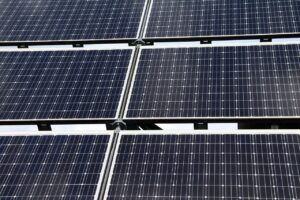
Guidance from the U.S. Department of Energy and the U.S. Energy Information Administration describes photovoltaic cells as devices that convert sunlight into direct-current electricity. In a small solar fan, that DC electricity can go directly to a DC motor, or it can pass through a charge controller and battery before powering the fan.
Direct-drive solar fans
A direct-drive model is the simplest design. The panel powers the motor when enough sunlight is available. As irradiance rises, the fan usually runs faster. When clouds pass, shade reaches the panel, or the sun sets, the fan slows or stops. This design works well when the need for airflow is mainly daytime heat relief. It also avoids the cost, weight, and maintenance associated with a battery.
The limitation is just as clear: direct-drive fans cannot provide reliable airflow at night or during extended cloudy periods. They are often suitable for greenhouse daytime heat buildup, small outbuildings, pet shelters with proper supervision, or remote spaces that only need ventilation during sunny hours.
Battery-backed solar fans
A battery-backed model stores solar energy so the fan can run after sunset or during weak sun. This setup is more useful for overnight ventilation, continuous air exchange, or locations where solar conditions fluctuate. The system still has to be sized for both real-time fan operation and battery charging. A small panel connected to a battery does not automatically deliver all-day reliability.
Battery quality is important. Look for clear information on battery chemistry, capacity in watt-hours, charge protection, low-voltage cutoff, replacement options, and safe operating temperature. Treat long runtime claims cautiously if the manufacturer does not explain the test conditions.
Where solar powered fans are most useful
The strongest applications share three conditions: the space needs ventilation more than refrigeration, the installation receives unobstructed sun, and the fan can move air through a low-resistance path. In those conditions, a solar powered fan can be practical and efficient.
| Use case | Why it can work | Main limitation |
|---|---|---|
| Greenhouses | Sunlight and heat buildup often occur together, so direct solar operation matches the load. | Vent area and shade control still matter; a fan alone may not prevent overheating. |
| Sheds and workshops | Air exchange can reduce stale, hot air without running grid wiring to a remote structure. | Dust, moisture, and tool storage may require better filtration or sealing. |
| RVs, boats, and cabins | Small DC loads are compatible with compact solar setups. | Roof space, shading, vibration, and battery integration must be checked carefully. |
| Outdoor seating or camping | Portable airflow can improve comfort in sunny weather. | Performance drops quickly under shade, clouds, or poor panel angle. |
| Attics | Solar output can coincide with roof heat gain during the day. | Air sealing, intake vents, roof design, and climate determine whether it helps. |
The U.S. Department of Energy notes in consumer cooling guidance that fans do not create cold air. They make people feel cooler by moving air across the skin and supporting evaporation. That is why a fan can feel useful on a porch or near a workbench, while having limited effect in an empty room. If the goal is to protect materials, reduce condensation, or exhaust hot air, the design should focus on measured air exchange rather than perceived comfort.
Key specifications to compare before buying
Solar fan listings often highlight panel wattage, but panel wattage alone is not enough. A meaningful comparison should connect power input, airflow output, and installation conditions.
Airflow rating
Airflow is commonly listed in CFM, or cubic feet per minute. Higher CFM is not always better. A small greenhouse or storage shed may need steady moderate airflow, while a larger attic or workshop needs a more carefully sized ventilation strategy. Check whether the CFM rating was measured in free air or under static pressure. Ducts, screens, louvers, filters, and roof vents add resistance, and resistance lowers real airflow.
Panel wattage and sun access
Solar output changes with location, season, time of day, weather, and panel angle. Department of Energy solar radiation guidance emphasizes that the strongest solar energy usually reaches a surface around solar noon, while clouds, local shade, and seasonal sun angle can reduce available power. For a fixed installation in the Northern Hemisphere, a panel generally performs best with strong southern exposure and minimal shading, although the exact tilt depends on latitude, roof geometry, and the load profile.
For small fans, even partial shade across the panel can noticeably reduce speed. If the panel will sit under tree shadows, near roof obstructions, or behind a railing, assume performance will be lower than the headline wattage suggests.
Motor type and efficiency
Brushless DC motors are common in compact solar fans because they suit DC power and can operate efficiently at small loads. Efficiency is not only about motor design, though. Blade shape, housing, guard design, duct friction, and controller behavior all affect how much air the fan moves per watt.
ENERGY STAR materials for residential ventilating fans use CFM per watt as an efficiency concept. Even if a solar powered fan is not in that exact certification category, CFM per watt is still a useful way to compare performance. A unit that moves more air for each watt of power can make better use of a small panel.
Weather protection and installation hardware
Outdoor fans should provide clear information about water resistance, UV exposure, corrosion resistance, cable length, connector type, and mounting method. For roof, wall, boat, and RV installations, water intrusion can be a bigger risk than the fan’s electrical load. Flashing, sealants, strain relief, and proper fasteners are not minor details. See also: clean energy.
What to know about attic installations
Solar attic fans are popular because attic heat is easy to feel and easy to blame for summer discomfort. The building-science picture is more nuanced. Research and guidance from organizations such as the Florida Solar Energy Center and the DOE Building America program have examined powered attic ventilation in hot climates and raised an important caution: powered attic fans can sometimes pull conditioned indoor air into the attic if the ceiling plane is leaky or if intake ventilation is inadequate.
A solar attic fan avoids using grid electricity while it runs, which is an advantage over a conventional powered attic ventilator. But free solar electricity does not automatically mean the house saves cooling energy. If the fan depressurizes the attic and draws cooled air through ceiling gaps, recessed lights, attic hatches, or duct leaks, the air conditioner may need to replace that lost conditioned air.
Before adding an attic fan, check three things:
- Air sealing: Seal obvious ceiling leaks, attic access panels, plumbing penetrations, and wiring gaps before relying on mechanical exhaust.
- Balanced intake: Exhaust fans need enough intake area, usually through soffit or lower roof vents, so they are not pulling air from the living space.
- Existing ventilation path: Passive ridge, soffit, gable, and roof vents may already provide part of the solution if they are correctly sized and unobstructed.
For complex roofs, humid climates, or homes with HVAC ducts in the attic, professional assessment is often more valuable than simply installing the biggest fan available. In many cases, attic air sealing, insulation, duct sealing, shading, or radiant control may deliver more predictable comfort benefits than mechanical attic exhaust alone.
How to size a solar powered fan sensibly
A practical sizing process starts with the problem, not the product. Are you trying to cool a person, exhaust hot air, reduce moisture, protect stored materials, or support plant health? Each goal points to a different airflow pattern.
- Define the space. Estimate volume by multiplying length, width, and height. A small enclosed shed and a tall greenhouse need different airflow strategies even if their floor areas are similar.
- Identify intake and exhaust paths. A fan cannot move much air if replacement air cannot enter. Plan where fresh air comes in and where warm or stale air exits.
- Match CFM to the job. Use manufacturer airflow data carefully, especially if the fan is connected to ducting, screens, louvers, or vents.
- Check solar access. Observe the panel location at different times of day. Morning or afternoon shade may matter more than expected.
- Decide whether runtime after sunset matters. If it does, compare battery capacity in watt-hours and verify realistic runtime at the intended fan speed.
- Plan maintenance. Dusty blades, dirty panels, blocked screens, and corroded connectors can reduce performance over time.
A sensible rule of thumb is to oversize the solar input modestly rather than choosing a panel that only matches the fan under ideal laboratory conditions. Real installations face heat, dust, non-ideal angles, cable losses, and cloud cover. That does not mean every fan needs a large panel; it means buyers should leave margin for real-world conditions.
Limitations and realistic expectations
A solar powered fan is best understood as a low-energy airflow tool. It can improve comfort, reduce stagnant air, and support ventilation where grid power is inconvenient. It cannot dehumidify air, lower wet-bulb temperature, or provide the same control as air conditioning. In hot and humid climates, ventilation can sometimes bring in more moisture, so use case and timing matter.
Noise is another practical issue. A small fan running at high speed may be more noticeable than a larger fan running slowly. For living spaces, workshops, cabins, and RVs, check sound ratings if they are available and read installation notes carefully. Vibration isolation can be just as important as the fan itself.
Safety also matters. Do not use a fan as the only protection for people, pets, batteries, chemicals, or temperature-sensitive equipment unless the consequences of failure are acceptable. Solar-powered devices can stop because of shade, storms, dust, wiring faults, controller failure, or battery depletion. Critical ventilation should include monitoring, backup power, or a fail-safe design.
Frequently asked questions
Does a solar powered fan work on cloudy days?
Usually yes, but performance is reduced unless it has a charged battery. A direct-drive fan depends on the panel’s immediate output, so clouds often reduce speed. A battery-backed fan can smooth out short interruptions, but only if the battery has enough stored energy.
Can a solar powered fan cool a room?
It can make people feel cooler by moving air, and it can exhaust hot air if there is a good ventilation path. It does not actively cool, dehumidify, or condition air like an air conditioner. In an empty closed room, a fan may simply circulate warm air.
Is a solar attic fan always worth it?
No. It may help in some homes, especially where daytime roof heat and attic ventilation are real problems, but results depend on air sealing, intake vent area, ducts, insulation, climate, and roof design. It should be considered as one part of a building-performance strategy, not a guaranteed energy-saving device.
What matters more, panel wattage or CFM?
Both matter, but they answer different questions. Panel wattage indicates potential power supply under favorable sun, while CFM describes air movement. The better question is whether the system can deliver the required airflow at the actual installation site and during the hours when airflow is needed.
Do I need a battery for a solar powered fan?
You need a battery only if you want the fan to run when sunlight is weak or unavailable. For daytime-only ventilation, a direct-drive fan can be simpler and more durable. For night use, variable weather, or more consistent airflow, a battery-backed design is more appropriate.